Health Tech2026.05.22
The Next Cancer Drug Might Be Built Inside Your Own Body
다음 항암제는 당신의 몸 안에서 직접 만들어질지도 모릅니다
읽기 도움말The Deal
A $7 Billion Bet on Making Medicine Inside the Body
몸 안에서 약을 만드는 기술에 70억 달러를 건 거래
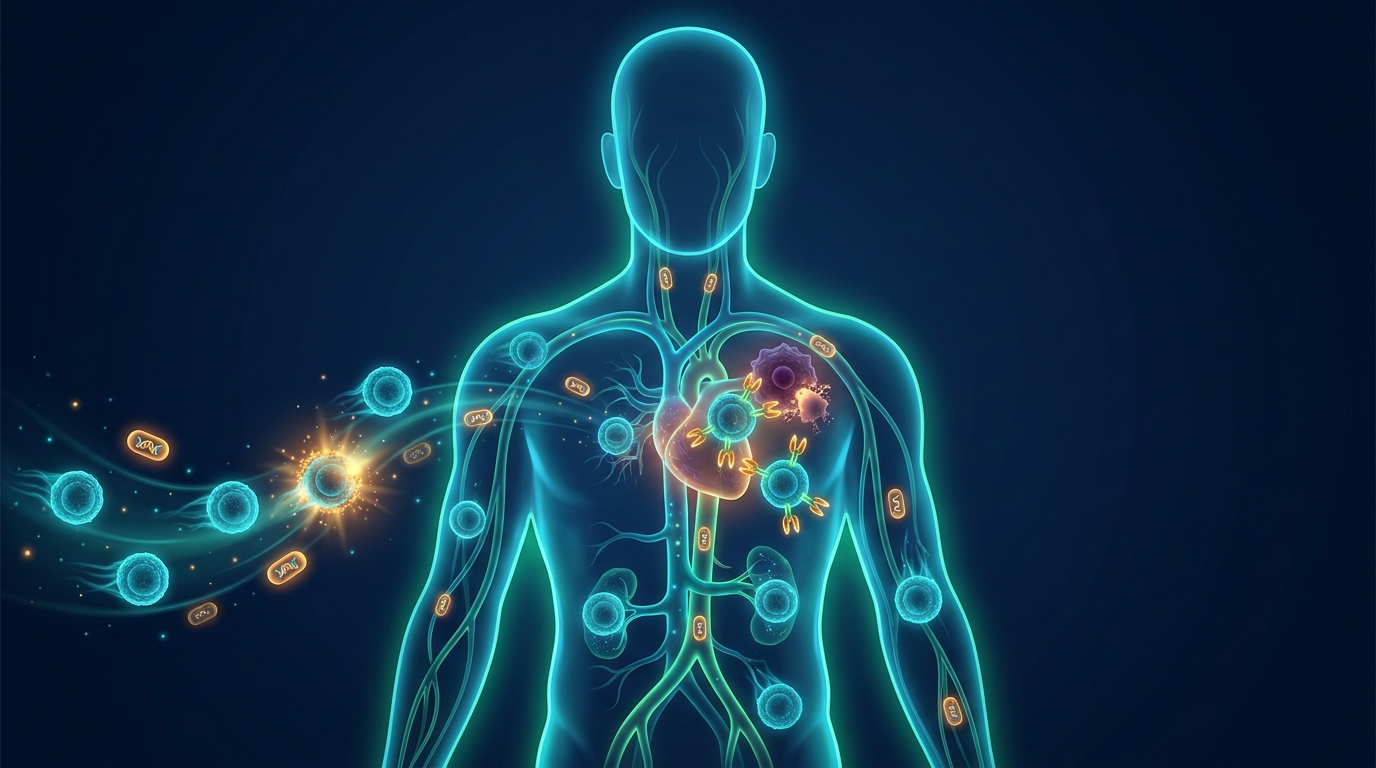
In April 2026, Eli Lilly announced it would pay up to seven billion dollars — three and a quarter billion upfront, the rest tied to milestones — to acquire a small American biotech called Kelonia Therapeutics. The acquisition was not about a finished cancer drug. It was about a platform that tries to do something pharmaceutical companies have never reliably done before: skip the factory and let the patient's own body build the medicine. The technology is called in vivo CAR-T cell therapy. The name is dense, but the idea is unusually simple. Doctors give a patient a intravenous infusion. Inside the body, that infusion finds the patient's T cells — the soldiers of the immune system — and reprograms them, in real time, to hunt down cancer. The medicine, in effect, is built inside the person who needs it.
2026년 4월, 일라이 릴리(Eli Lilly)는 켈로니아 테라퓨틱스(Kelonia Therapeutics)라는 미국의 작은 바이오텍을 최대 70억 달러 — 선지급 32억 5천만 달러, 나머지는 마일스톤 연동 — 에 인수한다고 발표했습니다. 이 인수는 완성된 항암제 때문이 아니었어요. 제약회사들이 한 번도 안정적으로 해본 적 없는 일을 시도하는 플랫폼 때문이었습니다. 공장을 건너뛰고, 환자의 몸이 직접 약을 만들게 하는 일이에요. 이 기술의 이름은 인체내(in vivo) CAR-T 세포 치료입니다. 이름은 어렵지만, 아이디어는 의외로 단순해요. 의사는 환자에게 정맥주사 한 번만 놓습니다. 몸 안에 들어간 그 주사약이 환자의 T세포 — 면역 체계의 군인 같은 존재 — 를 찾아내고, 실시간으로 그것들을 암세포 사냥꾼으로 재프로그래밍합니다. 사실상 치료제가 그 치료를 필요로 하는 사람의 몸 안에서 만들어지는 거예요.
The Problem
Why Traditional CAR-T Is Powerful, but Broken
기존 CAR-T가 강력하지만 무너져 있는 이유
To see why this matters, it helps to know how the current generation of CAR-T therapies works. A patient comes to a specialized hospital. Doctors draw out billions of the patient's own T cells. Those cells are flown — often on dry ice — to a manufacturing facility that may be on a different continent. Engineers genetically modify the cells to display a chimeric antigen receptor, a synthetic protein that recognizes the patient's specific cancer. Then the cells are shipped back, multiplied, and infused into the same patient, several weeks after the journey began. This process works — for some patients, dramatically. Approved CAR-T therapies have produced long, durable remissions in blood cancers that no other treatment could touch. But the system is also fragile and unfair. List prices typically range from three hundred seventy thousand to four hundred seventy-five thousand dollars, and the total cost of care can exceed one million dollars per patient. Manufacturing takes two to five weeks. During that wait, some patients deteriorate too quickly to ever receive their own cells. And because the process requires a specialized treatment center, most CAR-T therapy in the world is concentrated in a small number of hospitals in wealthy countries.
왜 이것이 중요한지 보려면, 현재 세대의 CAR-T 치료가 어떻게 작동하는지 먼저 알아야 합니다. 환자는 전문 병원을 찾습니다. 의사들은 환자의 T세포 수십억 개를 뽑아냅니다. 그 세포들은 — 종종 드라이아이스에 담겨 — 다른 대륙에 있을 수도 있는 제조 시설로 항공편으로 보내집니다. 엔지니어들은 세포가 키메라 항원 수용체(chimeric antigen receptor), 즉 그 환자의 특정 암을 인식하는 합성 단백질을 발현하도록 유전적으로 변형합니다. 그다음 세포들은 다시 같은 환자에게로 배송돼 증식되고 주입됩니다. 여정이 시작된 지 몇 주가 지난 뒤에 말이에요. 이 과정은 작동합니다 — 일부 환자들에게는 극적으로요. 승인된 CAR-T 치료제들은 다른 어떤 치료도 손댈 수 없었던 혈액암에서 길고 지속적인 관해를 만들어냈습니다. 그러나 그 시스템은 동시에 깨지기 쉽고 불공평합니다. 정가는 보통 37만~47만 5천 달러이며, 총 치료 비용은 환자 한 명당 100만 달러를 넘기도 합니다. 제조에는 2~5주가 걸려요. 그 기다림 동안 일부 환자들은 너무 빨리 악화돼서, 자신의 세포가 돌아오기도 전에 치료를 받을 수 없게 됩니다. 그리고 전문 치료 센터가 필요하기 때문에, 세계의 CAR-T 치료 대부분은 부유한 국가의 소수 병원에 집중돼 있어요.
The Approach
What Kelonia Built: A Particle That Programs Cells in Real Time
켈로니아가 만든 것: 세포를 실시간으로 프로그래밍하는 입자
Kelonia's platform, which the company calls in vivo Gene Placement System or iGPS, removes the manufacturing journey entirely. Instead of shipping cells out of the body, doctors infuse an engineered lentiviral particle — a viral envelope designed in the lab to be harmless on its own. The particle has been retargeted so that it docks only with human T cells. When it finds one, it delivers a genetic payload that codes for a chimeric antigen receptor. The patient's T cells then begin to express that receptor and, over the following days, multiply into a population of cancer-hunting cells without ever leaving the body. Kelonia's lead program, KLN-1010, targets a protein called B-cell maturation antigen, or BCMA. BCMA sits on the surface of multiple myeloma cells — a cancer of the plasma cells that affects roughly five thousand new patients each year in South Korea and well over a hundred thousand worldwide. Multiple myeloma is treatable but, until recently, almost always recurrent. Traditional anti-BCMA CAR-T therapies already exist, but they carry the same manufacturing burdens and access barriers as every other CAR-T product. KLN-1010 is the same biological target, attacked through a completely different route.
켈로니아가 인체내 유전자 배치 시스템(iGPS, in vivo Gene Placement System)이라고 부르는 이 회사의 플랫폼은 그 제조 여정 자체를 통째로 없앱니다. 세포를 몸 밖으로 보내는 대신, 의사는 공학적으로 설계된 렌티바이러스 입자(lentiviral particle) — 그 자체로는 무해하도록 실험실에서 설계된 바이러스 외피 — 를 정맥에 주사합니다. 이 입자는 오직 사람의 T세포에만 결합하도록 표적이 재설정돼 있어요. T세포를 찾으면, 키메라 항원 수용체를 코딩하는 유전자 화물을 전달합니다. 그러면 환자의 T세포는 그 수용체를 발현하기 시작하고, 며칠에 걸쳐 몸 밖으로 한 번도 나가지 않은 채 암 사냥 세포 집단으로 증식합니다. 켈로니아의 선도 프로그램인 KLN-1010은 B세포 성숙 항원(BCMA, B-cell maturation antigen)이라 불리는 단백질을 표적으로 합니다. BCMA는 다발골수종(multiple myeloma) 세포의 표면에 위치해요. 다발골수종은 형질세포의 암이며, 한국에서만 매년 약 5천 명의 신규 환자가 발생하고, 전 세계적으로는 10만 명을 훨씬 넘는 사람들에게 영향을 미칩니다. 다발골수종은 치료 가능하지만, 최근까지는 거의 언제나 재발했어요. 기존의 anti-BCMA CAR-T 치료제는 이미 존재하지만, 다른 모든 CAR-T 제품과 똑같은 제조 부담과 접근성 장벽을 안고 있습니다. KLN-1010은 같은 생물학적 표적을, 완전히 다른 경로로 공략합니다.
The Data
Early Results That Caught Eli Lilly's Attention
일라이 릴리의 눈길을 사로잡은 초기 결과
The reason Lilly was willing to commit billions to a company that had only just begun human studies was a small, but striking, dataset. In December, at the American Society of Hematology annual meeting, Kelonia presented Phase 1 results for KLN-1010. Four patients had been treated. Three received the higher of two tested doses; one received the lower. All four achieved minimal residual disease negativity, the most stringent definition of remission in multiple myeloma, meaning that even highly sensitive lab tests could not find a residual cancer cell. The safety profile was just as important as the response data. Traditional CAR-T therapies often trigger cytokine release syndrome — a violent immune reaction in which the body's signaling proteins flood the bloodstream and can cause dangerous fever, low blood pressure, and organ stress. In the KLN-1010 group, no patient experienced cytokine release syndrome at Grade 3 or higher, the threshold typically used to flag severe cases. There was no reported neurotoxicity, the other major safety concern with CAR-T, and the drops in blood cell counts were milder than what is typically seen with the manufactured product.
릴리가 사람 대상 연구를 막 시작한 회사에 수십억 달러를 걸 의향이 있었던 이유는, 작지만 인상적인 데이터셋이었습니다. 12월, 미국 혈액학회(American Society of Hematology) 연례 학술대회에서 켈로니아는 KLN-1010의 1상 결과를 발표했어요. 네 명의 환자가 치료받았습니다. 세 명은 시험된 두 용량 중 더 높은 용량을, 한 명은 더 낮은 용량을 받았어요. 네 명 모두 미세잔존질환 음성(minimal residual disease negativity) — 다발골수종에서 가장 엄격한 관해 정의이며, 매우 민감한 실험실 검사로도 단 하나의 잔존 암세포를 발견할 수 없다는 의미 — 을 달성했습니다. 안전성 프로파일은 반응률 데이터만큼이나 중요했어요. 기존 CAR-T 치료제는 종종 사이토카인 방출 증후군(cytokine release syndrome) — 신체의 신호 단백질이 혈류를 가득 채워 위험한 발열, 저혈압, 장기 부담을 일으킬 수 있는 격렬한 면역 반응 — 을 유발합니다. KLN-1010 그룹에서는 어떤 환자도 3등급 이상 — 보통 중증 사례를 표시하는 기준선 — 의 사이토카인 방출 증후군을 겪지 않았어요. CAR-T의 또 다른 주요 안전성 우려인 신경독성도 보고되지 않았으며, 혈구 수 감소도 제조된 제품에서 일반적으로 보이는 것보다 더 가벼웠습니다.
The Stakes
What Changes If Cancer Therapy Can Be Made Inside the Patient
암 치료가 환자 안에서 만들어질 수 있게 된다면 무엇이 바뀌는가
If in vivo CAR-T proves out in larger trials, the implications extend well beyond the four patients reported so far. The most immediate change would be access. A therapy delivered as a one-time intravenous infusion does not need a specialized cell-processing facility, a fleet of cryogenic couriers, or a vein-to-vein clock measured in weeks. It needs a hospital pharmacy that can hang an IV bag. Cancer centers in mid-sized Korean cities — and, eventually, in countries that currently have no CAR-T programs at all — could begin to offer the therapy. The cost structure could change too. Manufacturing a CAR-T product today involves a custom factory run for a patient, which is one of the reasons the price tag sits near half a million dollars. An in vivo product would be a more conventionally manufactured biologic — a vial of engineered viral particles produced once, at scale, and shipped like any other infused drug. Nobody can yet say whether savings would be passed to patients or absorbed as margin, but the underlying cost of goods would be fundamentally different. The reduced cost structure would also make CAR-T therapy accessible to healthcare systems currently priced out of it, including Korea's National Health Insurance Service, which has negotiated reimbursement rates for conventional CAR-T products that cover only a fraction of actual treatment cost. Another implication of in vivo delivery is geographic: the therapy can potentially be administered in any hospital with standard oncology infrastructure, rather than at the handful of specialized CAR-T manufacturing and infusion centers that exist today — bringing curative treatment to regional Korean hospitals without requiring transfer to a major university medical center. The remaining scientific question is durability: multiple myeloma is notorious for relapse, and the four KLN-1010 patients — while showing impressive early remission — have been monitored for months rather than years, leaving open whether a in vivo treatment can provide sustained immune surveillance equivalent to that delivered by persistently engrafted conventional CAR-T cells.
더 큰 임상 연구에서 인체내 CAR-T가 입증된다면, 그 영향은 지금까지 보고된 네 명의 환자를 훨씬 넘어 확장됩니다. 가장 즉각적인 변화는 접근성일 거예요. 한 번의 정맥주사로 전달되는 치료제는 전문 세포 가공 시설도, 극저온 운반 차량 군단도, 몇 주 단위로 측정되는 정맥-대-정맥(vein-to-vein) 시계도 필요로 하지 않습니다. 정맥주사 백을 걸 수 있는 병원 약국이면 충분해요. 한국의 중규모 도시 — 그리고 결국에는 현재 CAR-T 프로그램이 전혀 없는 국가들 — 의 암 센터들이 이 치료를 제공하기 시작할 수 있습니다. 비용 구조도 바뀔 수 있어요. 오늘날 CAR-T 제품을 제조하는 일은 환자 한 명을 위해 맞춤형 공장 가동을 하는 셈이며, 가격표가 50만 달러 가까이에 머무는 이유 중 하나입니다. 인체내 제품은 더 전통적으로 제조되는 바이오의약품 — 공학적으로 만들어진 바이러스 입자가 든 바이알을 대규모로 한 번 생산해 다른 주사제처럼 배송하는 것 — 이 됩니다. 그 절감이 환자에게 전달될지 마진으로 흡수될지는 누구도 아직 말할 수 없지만, 원가 구조 자체가 근본적으로 달라집니다. 줄어든 비용 구조는 또한 현재 가격 때문에 접근하지 못하는 의료 시스템에서 CAR-T 치료를 이용 가능하게 할 거예요. 한국 국민건강보험공단도 마찬가지예요. NHIS는 실제 치료 비용의 일부만 커버하는 기존 CAR-T 제품의 환급율을 협상했어요. 생체 내 전달의 또 다른 시사점은 지리적인 것이에요. 이 치료는 오늘날 존재하는 소수의 전문 CAR-T 제조 및 주입 센터가 아닌 표준 종양학 인프라를 갖춘 모든 병원에서 잠재적으로 투여될 수 있어요. 주요 대학 의료센터로의 이송 없이 지역 한국 병원에 치료적 치료를 제공하는 거예요. 남은 과학적 질문은 지속성이에요. 다발골수종은 재발로 악명 높아요. 인상적인 초기 완화를 보인 네 명의 KLN-1010 환자들은 수년이 아닌 수개월 동안 모니터링되었어요. 단 한 번의 생체 내 치료가 지속적으로 이식된 기존 CAR-T 세포가 제공하는 것과 동등한 지속적인 면역 감시를 제공할 수 있는지는 여전히 열린 질문이에요.
Patient action
What Four Patients Cannot Yet Tell Us
네 명의 환자가 아직 알려줄 수 없는 것
Four patients are a beginning, not a verdict. Phase 1 trials are designed primarily to detect safety problems and find a workable dose, not to prove that a drug works at scale. Lentiviral vectors, the delivery system at the heart of Kelonia's platform, have a long but not unblemished history in gene therapy — including rare cases in which the vector inserted its genetic payload near a cancer-related gene and caused secondary cancers years later. The risk in this new context is poorly understood, and only longer follow-up will tell whether the in vivo approach carries that same shadow. If you or a family member has been diagnosed with multiple myeloma, ask your oncologist about in vivo CAR-T trials at an academic medical center — because whether a infusion produces lasting remission can only be answered for your specific case by a physician who knows your full treatment history.
네 명의 환자는 시작이지, 평결이 아닙니다. 1상 임상 연구는 주로 안전성 문제를 발견하고 작동 가능한 용량을 찾기 위해 설계된 것이지, 그 약이 대규모로 작동한다는 것을 증명하기 위한 것이 아닙니다. 켈로니아 플랫폼의 핵심에 있는 렌티바이러스 벡터는 유전자 치료에서 길지만 완벽하지는 않은 역사를 가지고 있어요 — 벡터가 유전자 화물을 암 관련 유전자 근처에 삽입해 수년 후 이차 암을 일으킨 드문 사례들도 포함됩니다. 이 새로운 맥락에서의 위험은 잘 알려져 있지 않으며, 더 긴 추적관찰만이 인체내 접근법이 그 같은 그림자를 안고 있는지 알려줄 것입니다. 여러분이나 가족이 다발골수종 진단을 받았다면, 학술의료센터에서 진행 중인 생체 내 CAR-T 임상시험에 대해 종양 전문의에게 물어보세요. 단 한 번의 주입이 지속적인 완화를 가져올 수 있는지의 질문은 여러분의 전체 치료 이력을 아는 의사만이 여러분의 상황에 맞게 답할 수 있어요.
이 칼럼이 마음에 드셨나요?
새 칼럼이 발행되면 영문 + 한글 본문을 통째로 메일로 보내드려요. 매일 아침, 광고 없이.
언제든 한 번에 해지할 수 있어요.