Hook
Monday Morning, and the Market Froze
월요일 아침, 그리고 시장이 멈췄어요
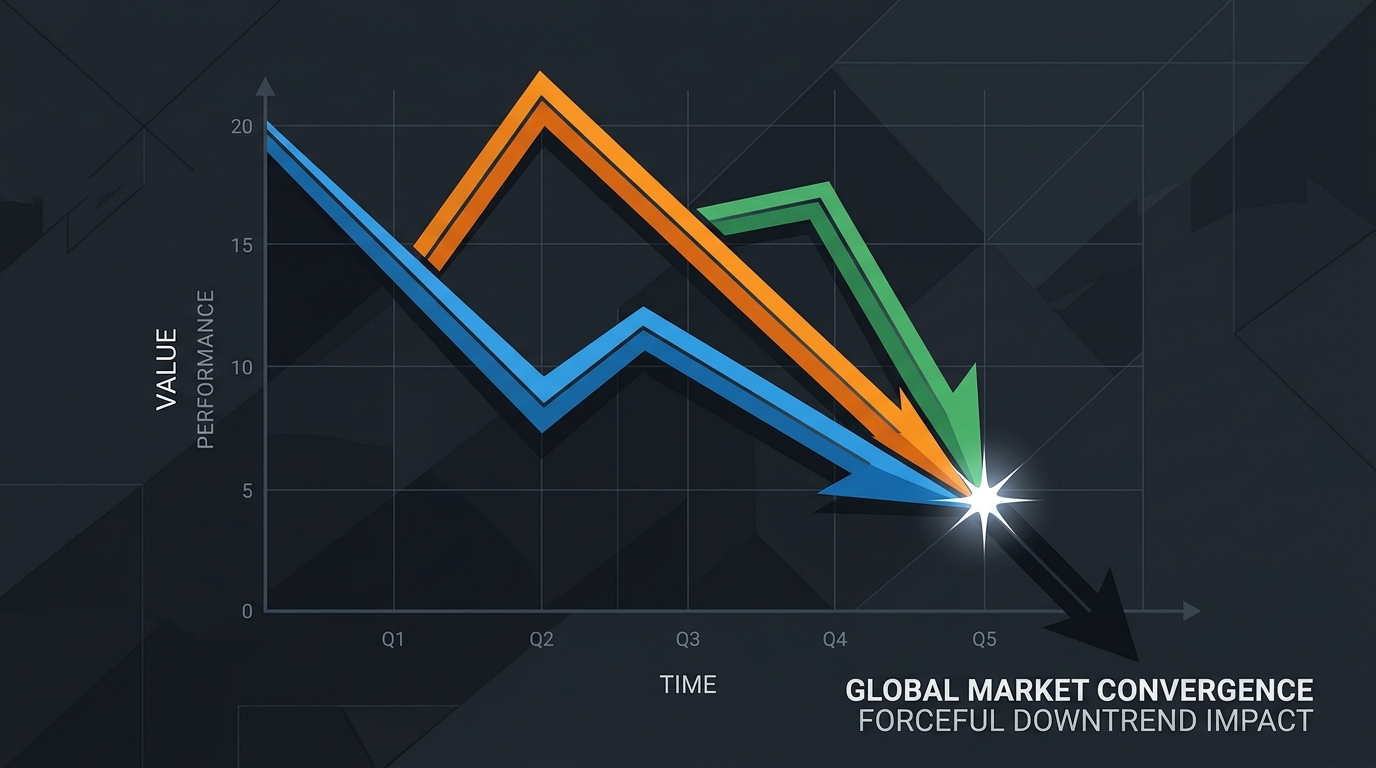
At exactly 9:03:42 on Monday , June 8, 2026, the Korea Exchange activated only its ninth circuit breaker in the KOSPI's history — halting all trading across the South Korean stock market for twenty minutes, just three minutes and forty-two seconds after the opening bell. In those twenty frozen minutes, three facts were already visible on every trading screen: the KOSPI had fallen 8.29% to 7,484 before the circuit breaker triggered, Samsung Electronics and SK Hynix had each lost nearly 10%, and no cause explained everything that had happened. What collapsed the KOSPI in four minutes was not one big shock but three smaller ones — one from Silicon Valley, one from Washington, and one from the Middle East — that arrived separately within twelve hours and converged the instant Korean markets opened.
2026년 6월 8일 월요일 오전 9시 3분 42초, 한국거래소는 코스피 역사상 아홉 번째 서킷브레이커를 발동했어요. 개장 후 불과 3분 42초 만에 한국 주식시장 전체 거래가 20분 동안 멈췄어요. 얼어붙은 그 20분 동안, 모든 트레이딩 화면에는 이미 세 가지 사실이 떠 있었어요. 서킷브레이커 발동 전 코스피 지수가 8.29% 떨어진 7,484포인트를 기록했고, 삼성전자와 SK하이닉스가 각각 10% 가까이 하락했으며, 그 어떤 단일 원인도 일어난 모든 일을 설명하지 못했어요. 코스피를 4분 만에 무너뜨린 것은 하나의 거대한 충격이 아니었어요. 실리콘밸리, 워싱턴, 중동에서 각각 출발한 세 개의 충격이 12시간 안에 따로 도착했다가, 한국 시장이 열리는 순간 한꺼번에 수렴한 결과예요.
The move
The Paradox of a 48% Revenue Jump That Crashed 14%
매출 48% 성장이 주가 14% 폭락을 부른 역설
The first shock came from Broadcom, one of the world's most critical semiconductor companies: it reported fiscal Q2 2026 revenue of $22.2 billion — up 48% year over year — with AI chip sales growing 143% to a record $10.8 billion. Despite those extraordinary numbers, Broadcom's stock fell 14% on June 4, because its for the next quarter came in at $16 billion — approximately $1.2 billion below what Wall Street had expected, and its full-year AI forecast was left unchanged. This is the "sell the news" paradox: when investors have already priced in perfection — assuming each quarter will beat expectations by a wide margin — even spectacular growth that merely falls slightly short of very high forecasts can trigger a sell-off. By the close of June 5, Broadcom's miss had erased over $1.3 trillion in combined market value from the global semiconductor sector in a session — the Nasdaq fell 4%, and the Philadelphia Semiconductor Index dropped more than 6%.
첫 번째 충격은 세계에서 가장 중요한 반도체 기업 중 하나인 브로드컴에서 왔어요. 브로드컴은 2026 회계연도 2분기 매출 222억 달러를 발표했어요. 전년 대비 48% 성장했고, AI 반도체 매출은 143% 급증해 108억 달러로 사상 최고치를 기록했어요. 그 놀라운 숫자에도 불구하고 6월 4일 브로드컴 주가는 14% 하락했어요. 다음 분기 가이던스가 160억 달러로 월가 기대치보다 약 12억 달러 낮았고, 연간 AI 매출 전망치도 그대로 유지했기 때문이에요. 이것이 '뉴스에 팔아라' 역설이에요. 투자자들이 이미 완벽한 실적을 전제로 주가를 형성해 놓은 상태에서 — 매 분기 기대치를 큰 폭으로 초과할 것이라 가정했을 때 — 놀라운 성장도 높은 전망치에 조금 못 미치면 매도세를 촉발할 수 있어요. 6월 5일 장이 닫힐 무렵, 브로드컴 가이던스 하나가 단 하루 동안 전 세계 반도체 섹터에서 1조 3,000억 달러 이상의 시가총액을 증발시켰어요. 나스닥은 4%, 필라델피아 반도체 지수는 6% 넘게 하락했어요.
Why now
The Jobs Report That Flipped the Rate Outlook
금리 전망을 뒤집은 고용 지표
The second shock arrived the same afternoon — the US Department of Labor reported that American employers added 172,000 nonfarm payrolls in May 2026, more than double the 80,000 consensus estimate and the strongest beat relative to expectations in over a year. A strong jobs report normally signals a healthy economy — but in June 2026, the number carried a dangerous implication: the Federal Reserve, which had been on an extended pause, now faced pressure to raise rates rather than cut them. Before the report, the probability of a rate hike by December 2026 sat at roughly 30%; within hours of the jobs release, it had climbed to 70% — a complete reversal from the two rate cuts the market had assumed at the start of the year.
두 번째 충격은 같은 날 오후에 왔어요. 미국 노동부는 2026년 5월 비농업 신규 고용이 17만 2,000명이라고 발표했어요. 시장 예상치인 8만 명의 두 배가 넘었고, 1년 이상 만에 기대치 대비 가장 큰 서프라이즈였어요. 강한 고용 지표는 보통 건강한 경제의 신호예요. 하지만 2026년 6월에는 위험한 함의를 담고 있었어요. 금리 동결 기조를 이어오던 연방준비제도가 이제 금리를 내리는 게 아니라 올려야 한다는 압박에 직면하게 된 거예요. 지표 발표 전, 2026년 12월 금리 인상 확률은 약 30%였어요. 하지만 고용 발표 후 몇 시간 만에 70%로 치솟았어요. 연초 두 차례 금리 인하를 기대했던 시장이 정반대로 돌아선 거예요.
Risk lens
Missiles, Markets, and a 40% Concentration Problem
미사일, 시장, 그리고 40% 집중 문제
The third shock came at dusk on June 7 — Iran at least three waves of ballistic missiles at Israeli territory in response to Israeli airstrikes on the southern suburbs of Beirut that had killed several Hezbollah commanders. The attack hit after Korean markets had already closed but hours before they would reopen — traders had no time to adjust, and the accumulated fear of all three shocks arrived simultaneously when the opening bell rang on June 8. South Korea's market is unusually exposed to this kind of convergence: Samsung Electronics and SK Hynix together represent roughly 40% of the KOSPI index — so a semiconductor shock, a dollar surge driven by rate-hike fears, and a geopolitical crisis all hit Korea simultaneously through the same two stocks.
세 번째 충격은 6월 7일 저녁에 왔어요. 이란이 베이루트 남부 교외에 대한 이스라엘의 공습에 대응해 이스라엘 본토에 최소 세 차례에 걸쳐 탄도 미사일을 발사했어요. 미사일 공격은 한국 시장이 이미 닫힌 뒤에 터졌지만, 다음 날 개장 몇 시간 전이었어요. 투자자들이 조정할 시간이 없었고, 세 충격에 쌓인 공포가 6월 8일 개장 벨과 동시에 한꺼번에 쏟아진 거예요. 한국 시장은 이런 충격의 수렴에 유독 취약한 구조예요. 삼성전자와 SK하이닉스의 코스피 비중이 합산 약 40%이기 때문이에요. 반도체 충격, 금리 인상 우려로 인한 달러 강세, 지정학적 위기가 동시에 같은 두 종목을 통해 한국에 집중되는 셈이에요.
What to watch
Recovery, Risk, and What the Next Trigger Will Be
반등, 리스크, 그리고 다음 촉매는 무엇인가
The day after the crash told a completely different story: on June 9, the KOSPI surged 8.18% — its strongest single-day recovery of 2026 — while SK Hynix jumped 16% and Samsung rebounded 9% as global chip stocks rallied overnight. The recovery's catalyst was also semiconductor-driven: Nvidia announced AI cooperation agreements with SK Hynix, LG Group, and Naver on the same day — a reminder that in a market built on two stocks, the concentration that creates crashes can generate equally rapid recoveries. Three structural questions will define Korea's equity market through the rest of 2026: whether the Fed actually raises rates in December, whether the Middle East conflict escalates further, and whether AI chip demand reignites after Broadcom's reset. Watch for the Federal Reserve's June 17 policy statement — if the FOMC signals that a rate hike is possible before year-end, the ripple through Korean equities, the won, and bond markets will be immediate, and whether Samsung and SK Hynix rise or fall that will tell you more about where markets are heading than any analyst forecast will.
폭락 다음 날은 전혀 다른 이야기를 보여줬어요. 6월 9일 코스피는 8.18% 급등해 2026년 최강의 하루 반등을 기록했어요. 글로벌 반도체 주가가 전날 밤 반등하면서 SK하이닉스는 16%, 삼성전자는 9% 올랐어요. 그 반등의 촉매 역시 반도체였어요. 엔비디아가 SK하이닉스, LG그룹, 네이버와의 AI 협력 협약을 같은 날 발표한 거예요. 두 종목에 집중된 시장은 폭락을 만들기도 하지만, 같은 집중도가 빠른 반등도 만든다는 사실을 보여준 셈이에요. 2026년 남은 기간 한국 증시를 결정할 세 가지 구조적 질문이 열려 있어요. 연준이 12월에 실제로 금리를 올릴 것인지, 중동 분쟁이 더 확대될 것인지, 그리고 브로드컴의 가이던스 하향 이후 AI 반도체 수요가 다시 불붙을 것인지예요. 6월 17일 연방준비제도 정책 성명을 주목하세요. 연방공개시장위원회가 연내 금리 인상 가능성을 시사할 경우, 한국 주식·원화·채권 시장에 즉각 파장이 올 거예요. 그날 아침 삼성전자와 SK하이닉스가 오르는지 내리는지가, 여러분이 읽게 될 어떤 애널리스트 전망보다도 시장의 방향을 더 정확하게 알려줄 거예요.
이 칼럼이 마음에 드셨나요?
새 칼럼이 발행되면 영문 + 한글 본문을 통째로 메일로 보내드려요. 매일 아침, 광고 없이.
언제든 한 번에 해지할 수 있어요.