Health Tech
CRISPR's Next Step: Base Editing Cures All 12 Sickle Cell Patients in Beam Therapeutics Trial
CRISPR 다음 단계: 빔 테라퓨틱스, 겸상적혈구병 환자 12명 전원 완치
읽기 도움말A Single Letter Fixed
Imagine you could fix a spelling mistake in the instruction manual of the human body — not by cutting out a whole page and rewriting it, but by correcting a wrong letter in a sentence. That is precisely what a new form of genetic medicine, called base editing, has now done for patients with sickle cell disease. On April 30, 2026, Beam Therapeutics published 18-month follow-up data in Nature Biotechnology showing that its base editing therapy, BEAM-101, achieved what scientists call a functional cure in all 12 patients with severe sickle cell disease enrolled in its Phase 1/2 clinical trial. No patient experienced a serious adverse event. All 12 maintained fetal hemoglobin levels above 40% — the biological threshold that, when sustained, effectively silences the symptoms of sickle cell disease. These results held steady at 18 months, suggesting the correction is durable, not temporary.
인체의 설명서에서 오탈자를 수정한다고 상상해보세요. 통째로 페이지를 잘라내고 다시 쓰는 것이 아니라, 단 한 문장에서 틀린 글자 하나를 고치는 방식으로 말이에요. 겸상적혈구병 환자들에게 염기 편집(base editing)이라는 새로운 유전자 의학이 바로 그 일을 해낸 것입니다. 2026년 4월 30일, 빔 테라퓨틱스는 Nature Biotechnology에 18개월 추적 관찰 데이터를 발표했습니다. 1/2상 임상시험에 등록된 중증 겸상적혈구병 환자 12명 전원에서 자사의 염기 편집 치료제 BEAM-101이 과학자들이 기능적 완치(functional cure)라 부르는 결과를 달성했다는 내용이었습니다. 중증 부작용을 경험한 환자는 한 명도 없었습니다. 12명 전원이 태아 헤모글로빈(fetal hemoglobin) 수치 40% 이상을 유지했는데, 이 수치는 지속될 경우 겸상적혈구병 증상을 사실상 억제하는 생물학적 기준값입니다. 이 결과는 18개월 시점에서도 안정적으로 유지되어, 교정 효과가 일시적이 아닌 지속적임을 시사합니다.
What Sickle Cell Actually Does
To understand why this matters — and why it is different from what came before — you need to know something about sickle cell disease itself. Sickle cell disease is caused by a single-letter mutation in the gene that encodes hemoglobin — the protein inside red blood cells that carries oxygen through the body. Because of this one-letter error, hemoglobin molecules clump together, distorting red blood cells into a rigid, crescent or "sickle" shape. These misshapen cells cannot flow smoothly through blood vessels; they block circulation, cause episodes of intense pain called crises, and progressively damage organs including the heart, lungs, and kidneys. The disease affects roughly 300,000 newborns worldwide each year, with the highest prevalence in sub-Saharan Africa, India, and among people of African descent in the United States. Until recently, treatment options were limited to managing symptoms, regular blood transfusions, or a bone marrow transplant — a high-risk procedure that requires finding a matched donor.
이것이 왜 중요한지, 그리고 이전의 치료법과 어떻게 다른지 이해하려면, 먼저 겸상적혈구병 자체에 대해 알아야 합니다. 겸상적혈구병은 헤모글로빈을 암호화하는 유전자의 단 하나의 염기 돌연변이로 인해 발생합니다. 헤모글로빈은 적혈구 내에서 산소를 온몸으로 운반하는 단백질입니다. 이 한 글자의 오류로 인해 헤모글로빈 분자들이 서로 뭉치면서, 적혈구가 딱딱하고 낫(겸상) 모양으로 변형됩니다. 이렇게 변형된 세포는 혈관을 원활히 통과하지 못하고, 혈액 순환을 막아 극심한 통증 발작(위기, crises)을 일으키고, 심장·폐·신장 등 장기에 점진적 손상을 유발합니다. 이 질환은 전 세계적으로 매년 약 30만 명의 신생아에게 영향을 미치며, 사하라 이남 아프리카, 인도, 그리고 미국 내 아프리카계 주민들에게 발병률이 특히 높습니다. 최근까지도 치료 선택지는 증상 관리, 정기적인 수혈, 또는 골수 이식에 국한되었는데, 골수 이식은 적합한 공여자를 찾아야 하는 고위험 시술입니다.
CRISPR Scissors vs. Base Editing Pen
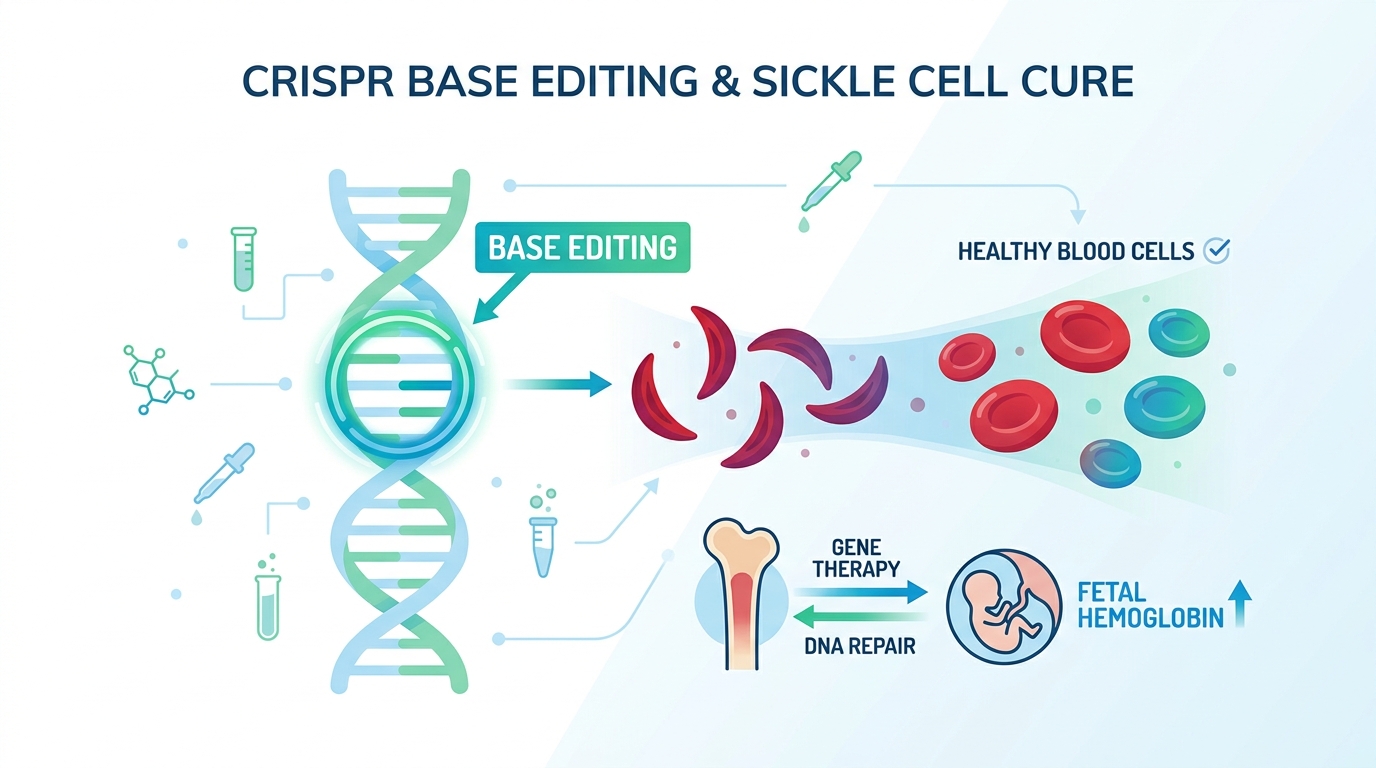
You may have heard of CRISPR — the gene-editing technology that won a Nobel Prize in 2020. The original CRISPR-Cas9 system works like a pair of molecular scissors: it cuts the DNA double helix at a targeted location, and the cell's natural repair mechanisms then attempt to fix the break, sometimes inserting a corrected sequence in the process. This approach proved powerful but imprecise — cutting DNA creates a risk of unintended edits at other locations in the genome, a problem called off-target effects. Base editing, pioneered by David Liu at the Broad Institute in 2016, takes a fundamentally different approach. Instead of cutting the DNA, the base editor travels to the target location and chemically converts one DNA letter into another — in this case, changing the mutated adenine (A) back to the correct guanine (G) — without ever breaking the double helix. Think of the difference between using scissors and a pen: CRISPR-Cas9 cuts; base editing corrects. BEAM-101 uses this base editing approach to reactivate fetal hemoglobin (HbF) — a form of hemoglobin that the body naturally produces before birth and switches off shortly after. Fetal hemoglobin does not polymerize or clump the way sickle hemoglobin does, so patients with high levels of HbF naturally have mild or no symptoms even if they carry the sickle cell mutation. BEAM-101 edits a genetic switch to keep HbF production running into adulthood.
CRISPR에 대해 들어보셨을 겁니다. 2020년 노벨상을 수상한 유전자 편집 기술입니다. 원래의 CRISPR-Cas9 시스템은 분자 가위처럼 작동합니다. DNA 이중 나선을 표적 위치에서 절단하고, 세포의 자연적인 복구 메커니즘이 손상을 복구하면서 교정된 서열을 삽입하는 방식입니다. 이 접근법은 강력하지만 부정확할 수 있었습니다. DNA를 절단하면 유전체 내 다른 위치에서 의도치 않은 편집이 발생하는 위험, 즉 탈표적 효과(off-target effects)가 생길 수 있습니다. 2016년 브로드 연구소의 데이비드 류(David Liu)가 개척한 염기 편집은 근본적으로 다른 접근법을 취합니다. DNA를 절단하는 대신, 염기 편집기가 표적 위치로 이동해 DNA 염기 하나를 화학적으로 다른 염기로 변환합니다. 이 경우, 돌연변이된 아데닌(A)을 올바른 구아닌(G)으로 되돌리는 방식이며, DNA 이중 나선을 끊지 않습니다. 가위와 펜의 차이를 생각해보세요. CRISPR-Cas9는 자르고, 염기 편집은 교정합니다. BEAM-101은 이 염기 편집 방식으로 태아 헤모글로빈(HbF)을 재활성화합니다. 태아 헤모글로빈은 출생 전에 자연적으로 생성되다가 출생 후 얼마 지나지 않아 스위치가 꺼지는 헤모글로빈의 한 형태입니다. 태아 헤모글로빈은 겸상 헤모글로빈처럼 중합되거나 뭉치지 않습니다. 따라서 HbF 수치가 높은 환자는 겸상적혈구 돌연변이를 보유하더라도 자연적으로 증상이 경미하거나 없습니다. BEAM-101은 HbF 생성을 성인기까지 계속 유지시키는 유전자 스위치를 편집합니다.
How the Treatment Works
The therapy is delivered through a one-time procedure. Stem cells are collected from the patient's own blood, edited outside the body using the base editor, quality-checked, and then infused back. There is no need to find a donor, and because the edited cells come from the patient's own body, the risk of immune rejection is dramatically reduced. The 12-patient dataset is small, as is standard for a Phase 1/2 trial, which is primarily designed to test safety. But the 100% response rate — every patient achieving fetal hemoglobin levels above the 40% threshold with no serious adverse events at 18 months — is clinically remarkable. For comparison, earlier first-generation CRISPR therapies for sickle cell achieved similar efficacy but with more complex manufacturing and, in some cases, longer conditioning regimens. That distinction matters. The manufacturing simplicity of base editing — because you are chemically converting rather than cutting and repairing — may translate into lower production costs and faster turnaround times, making the therapy more scalable than predecessors like Casgevy, the first CRISPR-based sickle cell treatment approved by the FDA in 2023.
치료는 1회성 시술로 이루어집니다. 환자 본인의 혈액에서 줄기세포를 채취하고, 체외에서 염기 편집기를 이용해 편집한 뒤, 품질 검증을 거쳐 다시 주입합니다. 공여자를 찾을 필요가 없으며, 편집된 세포가 환자 본인의 세포에서 유래하기 때문에 면역 거부 반응의 위험이 극적으로 줄어듭니다. 12명의 환자 데이터셋은 소규모인데, 이는 주로 안전성을 검증하기 위한 1/2상 임상시험의 일반적인 규모입니다. 하지만 100%의 반응률 — 모든 환자가 18개월 시점에서 중증 부작용 없이 태아 헤모글로빈 40% 기준을 달성 — 은 임상적으로 놀라운 결과입니다. 비교하자면, 초기 1세대 CRISPR 치료제들도 겸상적혈구병에서 유사한 효능을 달성했지만, 더 복잡한 제조 과정과 경우에 따라 더 긴 전처치 요법이 필요했습니다. 이 차이는 중요합니다. 염기 편집은 절단 후 복구가 아니라 화학적 변환 방식이기 때문에, 제조 단순성이 낮은 생산 비용과 빠른 처리 시간으로 이어질 수 있습니다. 이는 2023년 FDA가 승인한 최초의 CRISPR 기반 겸상적혈구 치료제인 캐스게비(Casgevy)보다 더 확장 가능한 치료법을 의미합니다.
The Price of a Cure
Casgevy — developed by Vertex and CRISPR Therapeutics — at a price of $2.2 million per patient, immediately triggering global debates about equitable access to gene therapy. Beam has not yet announced a price for BEAM-101, but the company has stated that manufacturing efficiency is a core design goal, and analysts expect a price in a similar range, with access negotiations with payers ongoing. The broader significance of BEAM-101 extends beyond sickle cell disease. Base editing is a platform technology: the same molecular machinery can be retooled, in principle, to correct other single-letter mutations linked to dozens of genetic diseases. Beam Therapeutics is already running trials for beta-thalassemia, a related blood disorder, and has earlier-stage programs targeting certain cardiovascular diseases and cancers. Beam expects to begin a pivotal Phase 3 trial by Q4 2026, with a target of enrolling several hundred patients across multiple continents. A successful Phase 3 trial would support a Biologics License Application (BLA) to the FDA, putting a base editing therapy on track for full market approval as early as 2028.
버텍스(Vertex)와 CRISPR 테라퓨틱스가 개발한 캐스게비는 환자 1인당 220만 달러의 가격으로 출시되면서, 유전자 치료의 공평한 접근성을 둘러싼 글로벌 논쟁을 즉각 촉발했습니다. 빔 테라퓨틱스는 아직 BEAM-101의 가격을 발표하지 않았지만, 제조 효율성이 핵심 설계 목표라고 밝혔으며, 애널리스트들은 유사한 수준을 예상하면서 보험사와의 접근성 협상이 진행 중입니다. BEAM-101의 더 넓은 의미는 겸상적혈구병을 넘어섭니다. 염기 편집은 플랫폼 기술입니다. 동일한 분자 기계를 원칙적으로 수십 가지 유전 질환과 연관된 다른 단일 염기 돌연변이를 교정하도록 재설계할 수 있습니다. 빔 테라퓨틱스는 이미 관련 혈액 질환인 베타-지중해빈혈(beta-thalassemia)에 대한 임상시험을 진행 중이며, 특정 심혈관 질환과 암을 대상으로 하는 초기 단계 프로그램도 보유하고 있습니다. 빔은 2026년 4분기까지 핵심 3상 임상시험을 시작할 계획이며, 여러 대륙에서 수백 명의 환자를 등록하는 것을 목표로 하고 있습니다. 3상 임상시험이 성공하면 FDA에 생물의약품 허가 신청(BLA)을 제출할 수 있고, 이르면 2028년에 염기 편집 치료제의 정식 시장 승인이 이루어질 수 있습니다.
Ten Years, One Letter
To appreciate the pace of this progress, consider that CRISPR itself was only first used to edit human cells in a laboratory in 2013 — just 13 years ago. Base editing, which refined the original technology to remove the double-strand cut, arrived in 2016. A decade later, it has already achieved what looks like a functional cure in humans. Experts not involved in the study have called the data "extraordinarily encouraging," while cautioning that the sample size remains small and that long-term durability beyond 18 months is still to be established. The critical question is whether the edited cells will continue to produce fetal hemoglobin at protective levels five, ten, or twenty years from now — a question only longer follow-up can answer. There is also the question of access. Sickle cell disease disproportionately affects populations in low-income countries — precisely those with the least capacity to afford a multi-million-dollar gene therapy. Both Beam and the broader global health community will need to develop partnerships with governments, insurers, and international health agencies to make this technology accessible where the disease burden is greatest.
이 발전 속도를 이해하려면, CRISPR이 처음으로 실험실에서 인간 세포를 편집하는 데 사용된 것이 불과 13년 전인 2013년이라는 사실을 생각해 보세요. 이중 가닥 절단을 제거해 원래 기술을 개선한 염기 편집은 2016년에 등장했습니다. 10년도 지나지 않아 이미 인간에게서 기능적 완치처럼 보이는 결과를 달성한 것입니다. 연구에 관여하지 않은 전문가들은 이 데이터를 "매우 고무적"이라고 평가하면서도, 표본 크기가 여전히 작고 18개월을 넘어서는 장기적 내구성은 아직 확립되지 않았다고 경고했습니다. 핵심 질문은 편집된 세포가 5년, 10년, 20년 후에도 보호 수준의 태아 헤모글로빈을 계속 생성할 것인지의 여부인데, 이는 더 긴 추적 관찰만이 답할 수 있는 질문입니다. 접근성 문제도 있습니다. 겸상적혈구병은 저소득 국가 인구에게 불균형적으로 영향을 미치는데, 이들은 수백만 달러에 달하는 유전자 치료를 감당할 능력이 가장 부족한 계층이기도 합니다. 빔 테라퓨틱스와 글로벌 보건 커뮤니티 모두, 질병 부담이 가장 큰 곳에서 이 기술에 접근할 수 있도록 정부, 보험사, 국제 보건 기관과의 파트너십을 구축해야 할 것입니다.
Patient action
Still, for the 12 patients in the trial — and for the hundreds of thousands of children born with sickle cell disease every year — what Beam Therapeutics published today represents something profound: the possibility of a life free from painful crises, organ damage, and the relentless management of a genetic condition. Gene therapy has promised cures before — and sometimes failed to deliver them at scale. But the trajectory from CRISPR's first laboratory use in 2013 to base editing's 100% functional cure in 2026 suggests that the arc of genetic medicine is bending, faster than most people expected, toward a world where the instruction errors we inherit at birth can simply be corrected. Beam Therapeutics will present full trial data at the European Hematology Association Congress in June 2026. The pivotal Phase 3 trial is expected to begin enrollment in Q4 2026. If the results hold, BEAM-101 could represent the next chapter in gene therapy — one written not with scissors, but with a , precise stroke of a pen. If you or someone you love carries a hereditary blood disorder, ask your doctor whether base editing clinical trials are currently enrolling patients — because the quiet beginning of precision gene correction may not stay quiet for long, and early awareness puts you ahead of the waiting list.
그럼에도 불구하고, 임상시험에 참가한 12명의 환자들에게 — 그리고 매년 겸상적혈구병으로 태어나는 수십만 명의 아이들에게 — 빔 테라퓨틱스가 오늘 발표한 것은 심오한 가능성을 의미합니다. 고통스러운 발작, 장기 손상, 유전 질환을 끊임없이 관리해야 하는 삶에서 벗어날 수 있는 가능성 말이에요. 유전자 치료는 이전에도 완치를 약속했고, 때로는 대규모로 그 약속을 이행하지 못하기도 했습니다. 하지만 2013년 CRISPR의 첫 실험실 사용에서 2026년 염기 편집의 100% 기능적 완치에 이르는 궤적은, 유전 의학의 궤도가 대부분의 사람이 예상했던 것보다 훨씬 빠르게 — 태어날 때 물려받은 유전적 오류를 단순히 교정할 수 있는 세계를 향해 — 구부러지고 있음을 시사합니다. 빔 테라퓨틱스는 2026년 6월 유럽혈액학회(EHA) 학술대회에서 전체 임상 데이터를 발표할 예정입니다. 핵심 3상 임상시험은 2026년 4분기에 등록을 시작할 것으로 예상됩니다. 결과가 유지된다면, BEAM-101은 유전자 치료의 다음 장을 쓰게 될지도 모릅니다. 가위가 아닌, 단 하나의 정밀한 펜 획으로 쓰인 장을 말이에요. 여러분이나 여러분이 아끼는 사람이 유전성 혈액 질환을 갖고 있다면, 현재 염기 교정 임상시험이 환자를 모집 중인지 의사에게 물어보세요. 정밀 유전자 교정의 조용한 시작이 오래 조용하지 않을 수 있고, 일찍 인식하는 것이 여러분을 대기자 명단보다 앞에 놓아줄 수 있어요.
이 칼럼이 마음에 드셨나요?
새 칼럼이 발행되면 영문 + 한글 본문을 통째로 메일로 보내드려요. 매일 아침, 광고 없이.
언제든 한 번에 해지할 수 있어요.