Workplace
The Cognitive Overload Fix: How Deliberate Calendar Design Is Giving Workers Their Focus Back
인지 과부하 해법: 의도적 캘린더 설계로 집중력을 되찾는 법
읽기 도움말The productivity paradox no one warned you about
You have more tools than ever. A project manager, a messaging platform, a document suite, and now several AI assistants layered on top. Each new tool was supposed to make work easier. So why does it feel harder? Researchers at Harvard Business School and UC Berkeley set out to answer exactly that question — and what they found is both validating and unsettling. Their study surveyed 12,000 "knowledge workers" across the US, UK, Germany, and Japan and found that 67% report experiencing "cognitive overload" — a state in which the volume and speed of information, decisions, and communication demands exceeds their mental processing capacity — on at least three days per week. That figure has risen from 54% in 2023. In other words, the problem has worsened significantly during the same period that AI tool adoption was supposed to be making work more manageable.
여러분은 그 어느 때보다 많은 도구를 갖고 있어요. 프로젝트 관리 도구, 메시지 플랫폼, 문서 도구 모음, 그리고 이제 그 위에 여러 AI 어시스턴트까지. 각각의 새 도구는 일을 더 쉽게 만들기 위한 것이었어요. 그런데 왜 일이 더 힘들게 느껴질까요? 하버드 경영대학원과 UC 버클리의 연구자들이 바로 그 질문에 답하기 위해 나섰어요 — 그리고 그들이 발견한 것은 위로가 되면서도 불안하게 만드는 내용이었어요. 연구팀은 미국, 영국, 독일, 일본의 12,000명 "지식 노동자"를 조사했어요. 그 결과 67%가 주 3일 이상 "인지 과부하"를 경험한다고 답했어요 — 정보, 결정, 소통 요구의 양과 속도가 정신적 처리 용량을 초과하는 상태예요. 이 수치는 2023년의 54%에서 올라간 거예요. 다시 말해, AI 도구 도입이 업무를 더 수월하게 만들어야 했던 바로 그 기간 동안 문제가 오히려 심각해진 거예요.
Every new tool adds a review tax
The counterintuitive finding at the heart of this research is that AI tools — designed to reduce workload — are themselves a significant contributor to cognitive overload. The mechanism is specific: each AI tool added to a workflow increases information review burden by an estimated 18 to 22%. Workers are not just receiving more AI-generated content; they must evaluate it, correct it, integrate it into their own thinking, and take responsibility for the final output. That is cognitive work that the AI cannot eliminate. The second driver is the "" expectation that pervades modern workplaces. A separate survey found that the average knowledge worker checks messages within 6 minutes of receiving a notification during working hours — not because they are inefficient, but because responding quickly has become an implicit performance . The result is a workday fragmented into hundreds of micro-interruptions, each one disrupting the mental state required for complex thought.
이 연구의 핵심에 있는 반직관적인 발견은, 업무 부담을 줄이기 위해 설계된 AI 도구들이 그 자체로 인지 과부하의 주요 원인이 되고 있다는 점이에요. 메커니즘은 구체적이에요: 워크플로우에 AI 도구 하나를 추가할 때마다 정보 검토 부담이 18~22% 증가해요. 직원들은 단순히 더 많은 AI 생성 콘텐츠를 받는 게 아니에요 — 그것을 평가하고, 수정하고, 자신의 사고에 통합하고, 최종 결과물에 책임을 져야 해요. 그건 AI가 없앨 수 없는 인지 작업이에요. 두 번째 원인은 현대 직장에 만연한 "상시 연결" 기대예요. 별도 조사에 따르면 평균적인 지식 노동자는 근무 시간 중 알림을 받은 후 6분 이내에 메시지를 확인해요 — 비효율적이기 때문이 아니라, 빠른 응답이 암묵적인 성과 신호가 되었기 때문이에요. 결과는 하루 수백 개의 미세 중단으로 분절된 근무일이에요 — 각각의 중단이 복잡한 사고에 필요한 정신 상태를 방해해요.
The hidden cost you can't see on a spreadsheet
"Cognitive overload" is not just feeling tired or stressed. Researchers at UC Berkeley's Greater Good Science Center linked chronic cognitive overload to measurable declines in three specific capacities: empathy (the ability to understand colleagues' perspectives), creativity (the ability to generate genuinely novel ideas), and long-term decision quality (the ability to evaluate trade-offs that matter over months, not minutes). These are precisely the capacities that distinguish strong performers from average ones — and overload erodes them silently. The economic cost is also beginning to be quantified. Organizations in the study that measured output quality rather than just volume found that teams experiencing high cognitive overload produced work with significantly more errors, required more revision cycles, and generated fewer breakthrough ideas in brainstorming sessions. The total cost, when factoring in rework and opportunity cost, consistently exceeded the productivity gains that drove AI tool adoption in the first place.
"인지 과부하"는 단순히 피곤하거나 스트레스를 받는 느낌이 아니에요. UC 버클리 그레이터 굿 사이언스 센터 연구자들은 만성적인 인지 과부하를 세 가지 구체적인 역량의 측정 가능한 저하와 연결시켰어요: 공감 능력(동료의 관점을 이해하는 능력), 창의성(진정으로 새로운 아이디어를 생성하는 능력), 장기 의사결정 품질(분 단위가 아닌 몇 달에 걸쳐 중요한 트레이드오프를 평가하는 능력). 이것들이 바로 높은 성과자와 평균 성과자를 구분하는 역량들이에요 — 그리고 과부하는 그것들을 조용히 갉아먹어요. 경제적 비용도 측정되기 시작했어요. 양뿐만 아니라 산출물의 질을 측정한 연구 내 조직들은, 높은 인지 과부하를 경험하는 팀들이 훨씬 더 많은 오류가 있는 결과물을 생산하고, 더 많은 수정 사이클이 필요하고, 브레인스토밍 세션에서 획기적인 아이디어를 더 적게 생성한다는 것을 발견했어요. 수정 작업과 기회비용을 고려한 총 비용은, 처음 AI 도구 도입을 이끌었던 생산성 이득을 일관되게 초과했어요.
Calendar architecture — designing focus, not just scheduling meetings
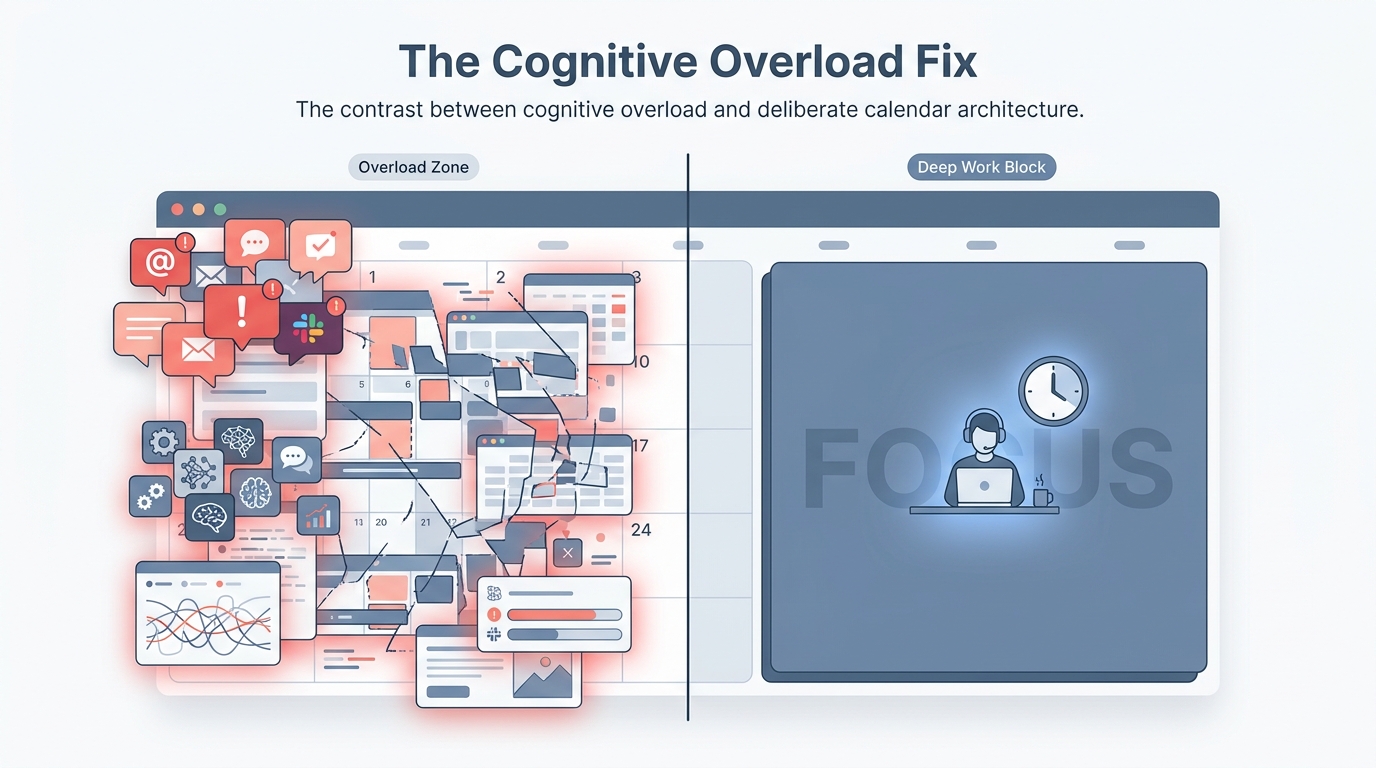
The most effective interventions the researchers identified share a common principle: they treat focus as a collective resource to be designed at the organizational level, not a personal responsibility to be managed by each individual. The leading approach is what Fast Company researchers call "calendar architecture" — the deliberate design of shared schedules to create synchronized periods of uninterrupted work across entire teams. Asana pioneered the approach with company-wide "deep work blocks" — protected time windows where no meetings are scheduled, no Slack messages are expected, and no email responses are required. The internal research results were striking: teams with structured deep work blocks completed complex projects 23% faster and reported 31% higher job satisfaction scores compared to control groups working in conventional schedules. GitLab and Dropbox have since adopted similar frameworks, adding "" communication norms that remove the implicit pressure to respond in real time.
연구자들이 파악한 가장 효과적인 개입들은 공통된 원칙을 공유해요: 집중력을 각 개인이 관리해야 할 개인적 책임이 아니라, 조직 차원에서 설계되어야 할 집단적 자원으로 다룬다는 점이에요. 선두적인 접근 방식은 패스트 컴퍼니 연구자들이 "캘린더 아키텍처"라고 부르는 것이에요 — 팀 전체에 걸쳐 방해 없는 작업의 동기화된 기간을 만들기 위해 공유 일정을 의도적으로 설계하는 거예요. Asana는 회사 전체적인 "딥워크 블록"으로 이 접근을 선도했어요 — 회의가 예약되지 않고, 슬랙 메시지가 기대되지 않고, 이메일 응답이 필요하지 않은 보호된 시간 창이에요. 내부 연구 결과는 놀라웠어요: 구조적 딥워크 블록이 있는 팀은 기존 일정으로 작업하는 대조군 대비 복합 프로젝트를 23% 빠르게 완료하고, 직무 만족도 점수가 31% 더 높다고 보고했어요. GitLab과 Dropbox는 이후 비슷한 프레임워크를 채택하면서, 실시간 응답에 대한 암묵적 압박을 없애는 "비동기 우선" 소통 규범을 추가했어요.
What actually works — and the numbers behind it
The HBR research identifies three specific organizational interventions that have produced consistent, measurable results. The first is decision-free afternoon blocks: protected time from 2pm to 5pm where no meetings, project management pings, or urgent requests are routed. Teams implementing this reported 34% improvements in self-reported focus quality within eight weeks. The second intervention is communication norms: written team agreements that distinguish which communications genuinely require real-time response — true emergencies — and which can wait hours or even a day. The third is a weekly "meeting audit" process: a structured review in which teams score each recurring meeting on whether it requires live synchronous presence or could be replaced by an async update, then eliminate or convert the lowest-scoring meetings. Organizations that implemented all three interventions in combination reported a 28% reduction in after-hours communication within three months.
HBR 연구는 일관되고 측정 가능한 결과를 만들어 낸 세 가지 구체적인 조직 개입을 파악해요. 첫 번째는 결정 없는 오후 블록이에요: 회의, 프로젝트 관리 알림, 긴급 요청이 오지 않는 오후 2시~5시의 보호된 시간이에요. 이를 실행한 팀들은 8주 이내에 자기 보고 기준 집중 품질이 34% 개선되었다고 보고했어요. 두 번째 개입은 비동기 우선 소통 규범이에요: 어떤 소통이 진정으로 실시간 응답이 필요한지 — 진짜 긴급 상황 — 그리고 어떤 것이 몇 시간 혹은 하루를 기다릴 수 있는지를 구분하는 서면 팀 합의예요. 세 번째는 주간 "회의 감사" 과정이에요: 팀이 반복되는 각 회의에 실시간 동기화된 참석이 필요한지 혹은 비동기 업데이트로 대체될 수 있는지를 점수로 매긴 다음, 가장 낮은 점수의 회의를 없애거나 전환하는 구조화된 검토 과정이에요. 세 가지 개입 모두를 조합해 실행한 조직들은 3개월 이내에 업무 외 시간 소통이 28% 감소했다고 보고했어요.
Always-on, amplified — the Korean workplace dynamic
South Korea sits at a distinctive intersection of the trends this research describes. Workplace messaging app penetration — particularly KakaoWork and Band — means that the boundary between working hours and personal time is structurally blurred: group chats that include managers create an ambient pressure to respond that operates well beyond the official workday. A 2025 survey by the Korea Labor Institute found that 61% of Korean white-collar workers check work messages after 9pm on weekdays, compared to a global average of 38%. The calendar architecture solutions identified in the research are technically straightforward to implement — but they require the explicit permission-giving that Korean workplace hierarchy can make difficult. When a manager's availability is equated with commitment, a protected deep work afternoon can read as detachment rather than discipline. Organizations that have successfully introduced these norms in Korean contexts have done so by framing them not as individual wellness initiatives but as performance design choices — making the business case concrete before asking employees to change their visible availability behaviors. In South Korea, where average weekly working hours remain among the highest in the OECD at around 38 hours per week — but with a significantly higher share of those hours spent in meetings compared to Nordic countries — the cognitive overload problem is structurally embedded in how Korean corporate culture defines visible commitment. Several Korean companies, including Kakao and Krafton, have experimented with meeting-free mornings — protecting the first two hours of each workday for individual focused work — and early internal reports suggest that teams maintaining these blocks consistently outperform those that do not on both output quality and employee satisfaction scores.
한국은 이 연구가 설명하는 트렌드들의 독특한 교차점에 있어요. 직장 메시지 앱 보급률 — 특히 카카오워크와 밴드 — 은 근무 시간과 개인 시간의 경계를 구조적으로 흐리게 해요: 매니저가 포함된 단체 채팅은 공식 근무 시간을 훨씬 넘어 응답해야 한다는 분위기 압박을 만들어요. 한국노동연구원의 2025년 조사에 따르면, 한국 화이트칼라 직원의 61%가 주중 오후 9시 이후에도 업무 메시지를 확인한다고 답했어요. 전 세계 평균 38%와 비교되는 수치예요. 연구에서 파악된 캘린더 아키텍처 해법들은 기술적으로는 실행하기 어렵지 않아요 — 하지만 한국 직장의 위계가 어렵게 만들 수 있는 명시적인 허가 부여가 필요해요. 매니저의 가용성이 헌신과 동일시될 때, 딥워크 오후 블록은 절제가 아닌 이탈로 읽힐 수 있어요. 한국 맥락에서 이런 규범을 성공적으로 도입한 조직들은, 그것을 개인 웰니스 이니셔티브가 아닌 성과 설계 선택으로 프레이밍해서 — 직원들에게 가시적 가용성 행동을 바꾸도록 요청하기 전에 비즈니스 케이스를 구체적으로 제시했어요. 주당 평균 근무 시간이 OECD 최상위권인 약 38시간을 유지하는 한국에서 — 그리고 그 시간 중 북유럽 국가들에 비해 훨씬 높은 비율이 회의에 쓰이는 한국에서 — 인지 과부하 문제는 한국 기업 문화가 눈에 보이는 헌신을 정의하는 방식에 구조적으로 내재되어 있어요. 카카오와 크래프톤을 포함한 여러 한국 기업들이 '회의 없는 오전'을 실험해봤어요. 각 근무일의 첫 두 시간을 개인 집중 업무를 위해 보호하는 거예요. 초기 내부 보고서에 따르면 이 블록을 일관되게 유지하는 팀이 그렇지 않은 팀보다 결과물 품질과 직원 만족도 점수 모두에서 더 나은 성과를 보이고 있어요.
Quick fix
Three things you can try this week
Your calendar is the most honest productivity data you have — start by blocking one 90-minute no-meeting window for next week, protecting it like any other commitment, and notice whether the quality of your focused work actually changes after just one week.
이 연구는 세 가지 실행 가능한 단계로 번역돼요. 첫째, 다음 주 캘린더를 점검하세요: 회의가 없는 90분 블록을 표시하고, 그 중 최소 두 개를 의도적인 딥워크 시간으로 보호하세요 — 전화기는 무음, 메시지 앱은 닫아두세요. 둘째, 팀에 비동기 우선 규범 하나를 제안해 보세요: 반복되는 회의 하나를 골라 대신 공유 문서 업데이트로 대체하자고 제안해 보세요. 결과가 달라지는지 측정해 보세요. 셋째, 자신의 과부하를 이름 붙이세요: 인지 과부하를 정기적으로 경험하고 있다면, 매니저에게 그것을 개인적인 성과 문제가 아닌 워크플로우 설계 문제로 가시화하세요. 연구는 이제 이것을 개인적인 불만이 아닌 조직 설계로 프레이밍할 때 다르게 받아들여질 만큼 충분히 탄탄해요. 집중력은 의지력의 문제가 아니에요. 시스템의 문제예요 — 그리고 시스템은 재설계될 수 있어요.
이 칼럼이 마음에 드셨나요?
새 칼럼이 발행되면 영문 + 한글 본문을 통째로 메일로 보내드려요. 매일 아침, 광고 없이.
언제든 한 번에 해지할 수 있어요.