AI Trend
The Race for Sovereign AI Chips: Why Nations Are Building Their Own Silicon
국가 AI 칩 주권 경쟁: 왜 각국은 자체 반도체를 만들려 하나
읽기 도움말The Vulnerability
The World Runs on One Factory — and Everyone Knows It
세계는 공장 하나로 돌아가요 — 모두가 알고 있어요
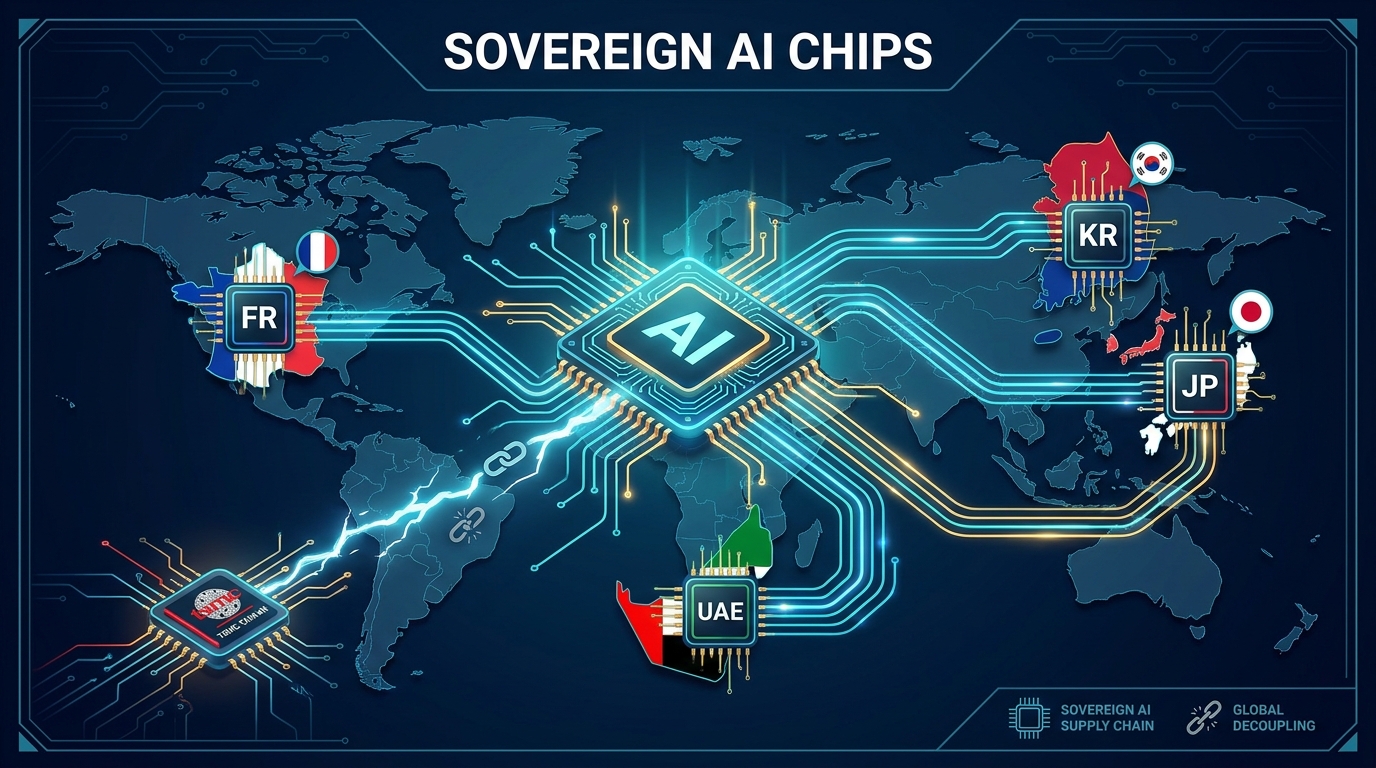
Ask yourself where the most advanced computer chips in the world come from — the ones powering the AI models that write code, diagnose disease, and translate languages in real time. More than ninety percent of the world's most advanced chips — at the three-nanometer node and below — are manufactured at a company: TSMC, located on the island of Taiwan. This extreme concentration in a geopolitically sensitive location has turned semiconductor self-sufficiency into one of the most urgent priorities in global technology strategy — and triggered a race that is now reshaping how nations think about AI power.
전 세계에서 가장 앞선 컴퓨터 칩이 어디에서 오는지 생각해본 적 있나요? 코드를 짜고, 병을 진단하고, 실시간으로 언어를 번역하는 AI 모델을 구동하는 바로 그 칩이요. 전 세계 최첨단 칩(3나노미터 이하 공정)의 90% 이상이 단 한 곳에서 만들어져요. 바로 대만에 있는 TSMC예요. 지정학적으로 민감한 지역에 생산이 이토록 집중되면서, semiconductor self-sufficiency(반도체 자급자족)은 글로벌 기술 전략에서 가장 시급한 과제 중 하나가 됐어요. 그리고 각국이 AI 역량을 어떻게 바라보는지를 바꾸는 경쟁이 시작됐죠.
The Trigger
US Export Controls Started a Chain Reaction
미국의 수출 규제가 연쇄 반응을 일으켰어요
The immediate trigger for this race was a series of US export controls — regulations that restricted the sale of advanced AI chips, including Nvidia's H100 and A100, to China and dozens of other countries. The controls, which escalated sharply between 2022 and 2025, sent a clear message to every nation watching: access to the chips that power AI can be cut off overnight for political reasons. The result is what analysts are calling the AI movement — a push by nations to develop domestic AI chip capabilities so they are not dependent on any foreign government or supplier for the technology that underpins their digital future.
이 경쟁의 직접적인 방아쇠는 미국의 일련의 export controls(수출 규제)였어요. Nvidia의 H100과 A100을 포함한 첨단 AI 칩을 중국과 수십 개국에 판매하는 것을 제한하는 규정이에요. 2022년부터 2025년 사이 급격히 강화된 이 규제는 지켜보는 모든 나라에 분명한 메시지를 보냈어요. AI를 구동하는 칩에 대한 접근이 정치적 이유로 하룻밤 사이에 차단될 수 있다는 거예요. 그 결과가 바로 분석가들이 sovereign AI 운동이라 부르는 흐름이에요. 자국의 디지털 미래를 떠받치는 기술을 두고 어떤 외국 정부나 단일 공급업체에도 의존하지 않으려는 각국의 움직임이에요.
Korea's Bet
South Korea Puts $14 Billion on the Table
한국이 약 19조 원을 테이블 위에 올렸어요
South Korea's government announced a commitment of fourteen billion US dollars to build a national AI chip cluster in Gyeonggi Province — one of the largest government technology investments in the country's history. The investment is not starting from zero: South Korea is already home to Samsung and SK Hynix, which together supply the majority of the world's (High Bandwidth Memory) — the specialized memory chips that sit alongside AI accelerators and determine how fast they can process data. The new investment targets logic chip design and foundry capacity — the parts of the supply chain where Korea has historically been weaker than TSMC, but where the government now sees the greatest strategic gap to close.
한국 정부는 경기도에 국가 AI 칩 클러스터를 구축하기 위해 미화 140억 달러(약 19조 원)를 투입하겠다고 발표했어요. 이는 한국 역사상 가장 큰 단일 정부 기술 투자 중 하나예요. 이 투자가 맨바닥에서 시작하는 건 아니에요. 한국에는 이미 삼성과 SK하이닉스가 있고, 두 회사는 AI 가속기 옆에 붙어서 데이터 처리 속도를 결정하는 전문 메모리 칩인 HBM(고대역폭 메모리)의 세계 공급 대부분을 담당하고 있어요. 이번 투자는 로직 칩 설계와 파운드리 역량에 초점을 맞춰요. 이 supply chain(공급망) 부분에서 한국은 역사적으로 TSMC보다 약했지만, 정부는 지금 여기서 전략적 격차가 가장 크다고 보고 있어요.
The Global Picture
Korea Is Not Alone — a New Silicon World Order Is Forming
한국만이 아니에요 — 새로운 반도체 세계 질서가 형성되고 있어요
Japan's RAPIDUS project, backed by the national government and partnered with IBM, is targeting two-nanometer chip production by late 2027 — a direct challenge to TSMC's dominance at the frontier. France and the European Union are investing over one billion euros in AI computing , partly to support companies like Mistral AI that need guaranteed access to domestic compute to satisfy strict European data residency regulations. The UAE, seeking to position itself as a Middle Eastern AI hub, announced plans to acquire one hundred thousand Nvidia GPUs and has partnered with US firms including Microsoft and G42 to build out its national AI . For South Korea, the competitive landscape is particularly intense because its chip manufacturing expertise — concentrated in DRAM and NAND flash at Samsung and SK Hynix — does not directly translate into the logic chip domain where AI inference hardware runs, meaning the country must invest in new architectural expertise while defending its existing memory franchise.
일본 정부가 지원하고 IBM과 협력하는 RAPIDUS 프로젝트는 2027년 말까지 2나노미터 칩 생산을 목표로 해요. TSMC의 최첨단 지배력에 대한 직접적인 도전이에요. 프랑스와 유럽연합은 자국 AI 컴퓨팅 인프라에 10억 유로 이상을 투자하고 있어요. 유럽의 엄격한 데이터 현지화 규정을 충족하기 위해 국내 컴퓨팅 접근성이 보장되어야 하는 Mistral AI 같은 기업을 지원하려는 목적도 있어요. 중동 AI 허브로 자리매김하려는 UAE는 Nvidia GPU 10만 개 확보 계획을 발표하고, Microsoft·G42 등 미국 기업과 협력해 국가 AI infrastructure(인프라)를 구축하고 있어요. 한국의 경우 경쟁 환경이 특히 치열해요. 삼성과 SK하이닉스의 DRAM 및 NAND 플래시 메모리에 집중된 칩 제조 전문성이 AI 추론 하드웨어가 실행되는 로직 칩 분야로 직접 전환되지 않아요. 따라서 기존 메모리 사업을 방어하는 동시에 새로운 아키텍처 전문성에 투자해야 한다는 의미예요.
What you can do
When Chips Become a National Security Asset
칩이 국가 안보 자산이 될 때
What is striking about this wave of investment is the framing: governments are no longer talking about AI chips purely in economic terms — they are explicitly describing chip access as a matter of national security, equivalent in strategic importance to energy independence or food security. As you follow global technology news, the phrase ' AI' signals something worth tracking: when national governments treat AI chip supply as a strategic security matter on par with energy or defense, the investment decisions that follow reshape entire industries — and careers — for a decade.
이번 투자 물결에서 눈에 띄는 건 표현 방식이에요. 각국 정부는 AI 칩을 더 이상 순수한 경제 용어로만 이야기하지 않아요. 에너지 독립이나 식량 안보와 전략적으로 동급인 국가 안보 문제로 명시적으로 설명하고 있어요. 글로벌 기술 뉴스를 팔로우하면서, '소버린 AI'라는 표현은 여러분이 추적할 가치가 있는 것을 신호해요. 각국 정부가 AI 칩 공급을 에너지나 국방과 동등한 전략적 안보 문제로 취급하기 시작할 때, 그 뒤를 따르는 투자 결정은 10년간 산업 전체와 여러분의 커리어를 재편해요.
이 칼럼이 마음에 드셨나요?
새 칼럼이 발행되면 영문 + 한글 본문을 통째로 메일로 보내드려요. 매일 아침, 광고 없이.
언제든 한 번에 해지할 수 있어요.